
Cuba Is Next
The pressure campaign is real. The endgame isn't.

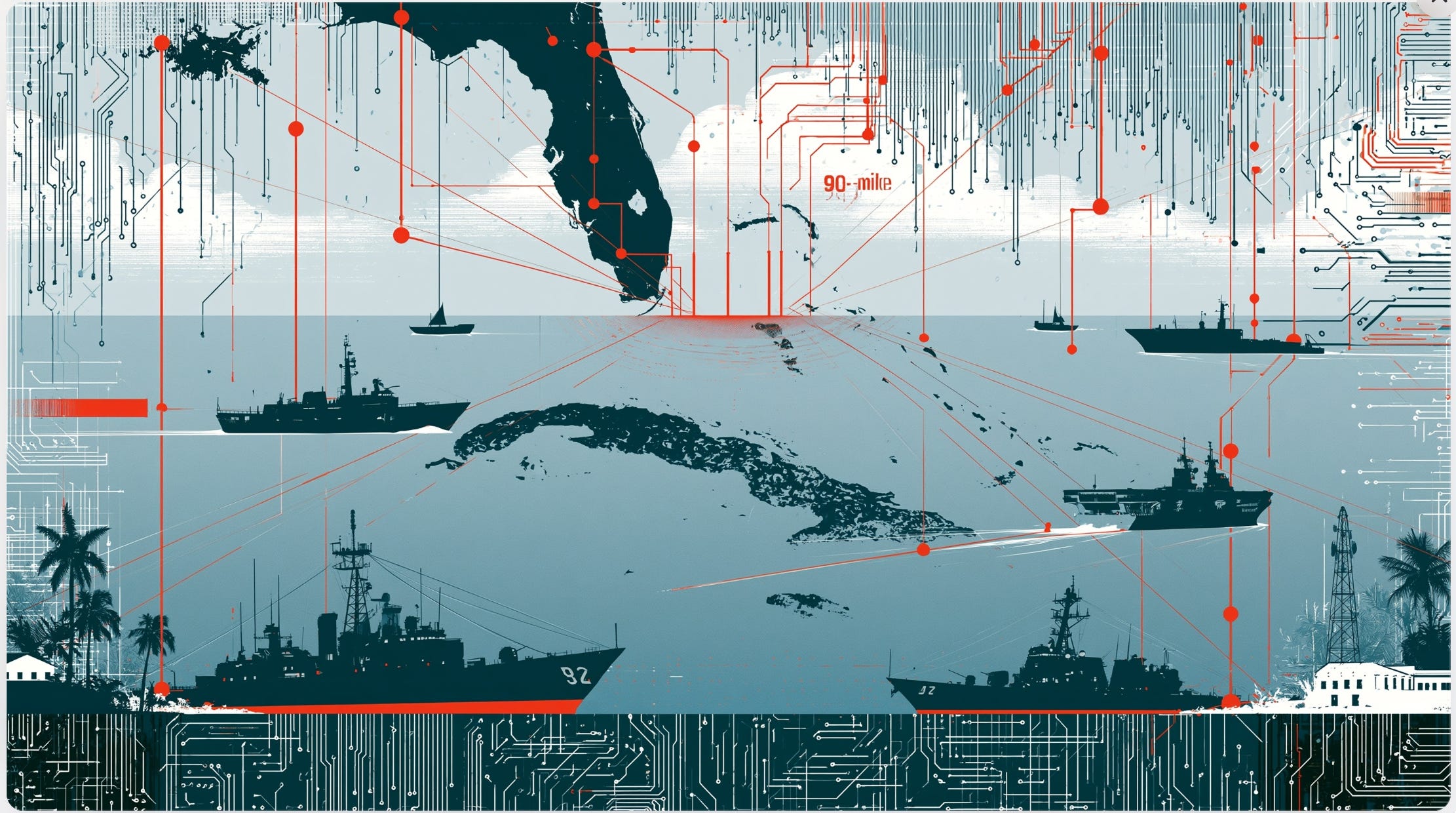
Let Me Tell You About a Delivery
Here’s the thing about dropping a piano on someone.
Technically — legally, even — that’s a delivery. You picked up an object. You moved it from one place to another. Delivered. The piano arrived. These are facts.
On January 3rd, U.S. special operations forces entered Caracas and removed Nicolás Maduro from power. The Department of Justice described it as a “law enforcement operation” on drug and arms trafficking charges, which is, technically, a description of what happened, in the same piano sense.
Now. Cuba and Venezuela had been close allies for decades. Cuba didn’t just like Venezuela — Cuba basically staffed Venezuela, its security services, its intelligence apparatus, its presidential protection detail. So when U.S. forces went into Caracas, they went into a building full of Cubans doing their jobs. According to multiple sources cited by CBS News, the Cuban government says 32 of its military and police officers were killed in the January operation.
Write that number down. It is the load-bearing fact in everything that follows.
What Happens When You Turn Off Someone’s Lights
After the operation, the Trump administration moved to strangle Cuba’s oil supply. The United States began blocking oil tankers heading to Cuba, targeting companies such as Mexican state-owned Pemex and threatening responsible countries with tariffs should they resist. Mexico complied — whether from U.S. pressure, domestic political calculation, or some quiet agreement on something else, the record doesn’t clearly say so. The result is that Cuba is now in genuine energy freefall. Air France suspended flights to Havana because there wasn’t enough jet fuel to refuel the planes. The tourism industry — most of what keeps the island economically functional — isn’t functioning.
The lights in Havana go out for hours at a time. People are burning wood for fuel. That is the condition of the island right now.
The Man They Brought Into the Room
On May 14th, CIA Director John Ratcliffe flew to Havana. He led a U.S. delegation to meet with Cuban government officials as the island grappled with the collapse of its energy sector amid spiraling relations with the U.S. Ratcliffe met with Raúl Castro’s grandson, Raúl Guillermo Rodríguez Castro; Interior Minister Lázaro Álvarez Casas; and the head of Cuban intelligence services. The official message, per the CIA: the United States is prepared to engage seriously on economic and security issues, but only if Cuba makes fundamental changes.
That sounds like diplomacy. It has the shape of an offer.
Here is the other thing that happened in that room.
Ratcliffe brought along one of the covert operators involved in the mission to capture Nicolás Maduro. Ratcliffe made a point of introducing the paramilitary leader to the Cubans as the one who killed their people in Venezuela, several sources told CBS News. The CIA declined to comment.
Think about what that is, mechanically. Nobody said anything threatening. Nobody needed to. One man’s presence in one room communicated a very specific message to the people sitting across the table — people who knew exactly who died in January, and how, and where. It is coercive diplomacy at its most compressed: the threat and the messenger are the same object.
Here’s where I have to be honest with you, though (this is the part where the voice in your head goes uh oh): that image is consistent with two completely different strategies. Strategy One is preparation for military action. Strategy Two is maximum pressure, designed to force a negotiated transition without firing a shot. The Ratcliffe visit fits both readings with equal precision. Anyone who tells you with certainty which one it is isn’t reasoning — they’re pattern-matching. We will come back to this.
The Indictment Arrives on Schedule
Six days after the Havana meeting, federal prosecutors unsealed an indictment on May 20th charging former Cuban President Raúl Castro and five former Cuban military pilots in the 1996 shootdown of two civilian planes belonging to the exile group Brothers to the Rescue. Castro, Cuba’s defense minister at the time, is alleged to have ordered the attack, which killed four men, including three American citizens and one permanent resident.
Officials announced it on Cuban Independence Day at Freedom Tower in Miami, a building known for processing thousands of Cuban refugees in the 1960s and ‘70s. Acting Attorney General Todd Blanche insisted this was not a show indictment but the result of 30 years of investigative work. That may be completely true. It is also true that in a February 2026 letter, several lawmakers, including Rep. Mario Díaz-Balart, urged the Justice Department to consider indicting Raúl Castro — meaning the timing was not purely organic. The indictment was filed on April 23rd, held for nearly four weeks, then unsealed on Cuba’s Independence Day, the same morning the carrier arrived in the Caribbean.
Coincidence is a word. It’s a word I’m going to decline to use here.
What the indictment builds, structurally, is a legal architecture: Raúl Castro is now a fugitive from U.S. justice. That creates the same “law enforcement” framing that characterized the Maduro operation. It doesn’t prove that framing will be used again. It enables it to be used again if someone decides to use it.
They Kept a Carrier Out of Retirement
On the same day as the indictment, the United States deployed the aircraft carrier USS Nimitz and its accompanying strike group into Caribbean waters, a move that coincided with the unsealing of murder charges against Raúl Castro and an intensifying pressure campaign against Havana.
The Nimitz is 51 years old. The carrier was set to be decommissioned in 2026, but the Navy announced in March 2026 that it was extending its service life to March 2027. The honest reason for the extension: the new Ford-class carriers are delayed — the USS John F. Kennedy is two years behind schedule due to problems with its Advanced Arresting Gear and Advanced Weapons Elevators. So the life extension has a mundane mechanical explanation. The Navy needed a body to fill a slot.
What also happened: the Nimitz’s arrival bolsters a still-strong armada in the region, including the Iwo Jima Amphibious Ready Group with the 22nd Marine Expeditionary Unit, the guided-missile cruiser USS Lake Erie, and the littoral combat ship USS Billings.
That is not a transit. That is a regional force posture that has been continuously elevated since January 3rd.
A Startup in Hangzhou Is Watching All of This
Now here is where it gets genuinely strange — in a way that would have seemed like bad science fiction a decade ago, and now is just another Tuesday.
Jingan Technology, a civilian startup founded in 2021 in Hangzhou, uses artificial intelligence and data analytics to analyze national security and defense challenges. It concluded that if the U.S. were to use force against Cuba, it would most likely take the form of a rapid “decapitation and paralysis” operation aimed at regime change, rather than a large-scale invasion. The company based its assessment on the “rhythm” of U.S. military deployments around Cuba — which it said intensified in recent months — and on political cycles.
Now. I need to tell you something about Jingan before you update your priors too aggressively.
This is the same company that, when U.S.-Israel operations against Iran began in March, claimed its platform had tracked B-2A stealth bombers — the least detectable aircraft ever constructed — during their return flight from Iranian targets. Defense analysts found that particular claim almost certainly exaggerated. So Jingan has a credibility ceiling worth noting.
What Jingan’s Cuba analysis actually tells us is not what the United States has decided to do. It tells us what is observable from outside, by people pointing satellites and signal data at a 90-mile stretch of water. Their conclusions are an inference from the same open-source threads you and I can pull. That’s worth something. It’s just not the same thing as intelligence.
Why Cuba Is Not Venezuela (And This Matters Enormously)
The CSIS assessment from June 3rd is worth reading carefully because it is careful. Here is its core:
Cuba is not Venezuela. The Cuban Communist Party is far better institutionalized than Venezuela’s kleptocratic regime. Even if a decapitation strike were successful, the question remains: what happens next? Like Iran, the Cuban government has been fortifying itself for decades against possible kinetic strikes from the United States. The most likely immediate outcome would not be quick regime collapse but instead a hardline response led by the Communist Party, the Revolutionary Armed Forces, intelligence services, and the military-economic mega-conglomerate GAESA. Center for Strategic and International Studies
GAESA — Grupo de Administración Empresarial S.A. — is not a part of the Cuban state. It is the Cuban state, reorganized as a military-owned conglomerate controlling tourism, retail, import-export, and foreign investment. You cannot decapitate an institution. You can only make it defensive and angry. Ask Iran how that went.
Here is the occupation math, which the “decapitation and paralysis” crowd prefers not to discuss: stability operations doctrine calls for roughly one security force member per 50 civilians with no active insurgency. Cuba has ten million people. The math floor is 200,000 external troops. Haiti, 90 miles east of Cuba, couldn’t attract 2,500 peacekeepers after years of U.S. prodding.
There is no plan for day two. There has never been a plan for day two.
The Argument This Piece Has to Answer
Here is the strongest objection to everything you’ve just read, and I’m going to give it to you straight because it deserves it.
Everything described in this piece — the economic strangulation, the indictment creating personal legal jeopardy for Raúl Castro, the carrier on station, the paramilitary officer introduced by name in a Havana conference room — is also the exact playbook you run if your goal is to force a negotiated transition without firing a shot—maximum pressure, credible threat, off-ramp visible. Ratcliffe urged Cuban officials to take a lesson from the January 3rd operation that toppled Maduro. That framing cuts both ways: it’s a threat, but it also implies a message — you can avoid this.
Raúl Castro’s grandson previously met secretly with Secretary of State Marco Rubio on the sidelines of a Caribbean Community summit in St. Kitts in February. High-level contact has continued since the Ratcliffe visit, including the head of U.S. Southern Command meeting with top Cuban military officials at the edge of Guantanamo Bay.
That is a lot of talking for a government that has allegedly already made up its mind.
The honest answer — the one that doesn’t feel satisfying but is the only defensible one — is: we don’t know which strategy this is. The pressure is real either way. The threat is real either way. Whether this ends in a deal or a disaster depends on decisions that haven’t been made yet, by people who may not have made up their minds, in a situation that is moving fast.
The Part That Should Keep You Up at Night
Which brings us to the thing that actually concerns historians more than intentions ever do.
In October 1962, U.S. pilot Rudolf Anderson was killed when his U-2 was shot down over Cuba. Diplomacy prevailed. In February 1898, the USS Maine exploded in Havana harbor — the cause is still disputed, probably a boiler accident — and within four months, the United States was at war with Spain. It had acquired Cuba, Puerto Rico, and the Philippines. Nobody planned that in January of 1898.
The risk here is not primarily about intention. It’s about proximity, pressure, and the physics of accidents in systems under stress. Since mid-April, the U.S. has conducted at least 25 military surveillance flights near Cuba’s coasts. A carrier strike group is on station. An indictment unsealed the same morning the carrier announced its arrival. A paramilitary officer was introduced by name in a Havana conference room.
None of those things, individually, is a declaration of war. Together they are a system under pressure, with hair-trigger proximity and no coherent answer to what happens when the negotiated transition doesn’t happen — or when something goes wrong that nobody intended.