
The Slop Janitor Cometh
A startup founder appointed himself the arbiter of human writing. Nobody asked the writers.

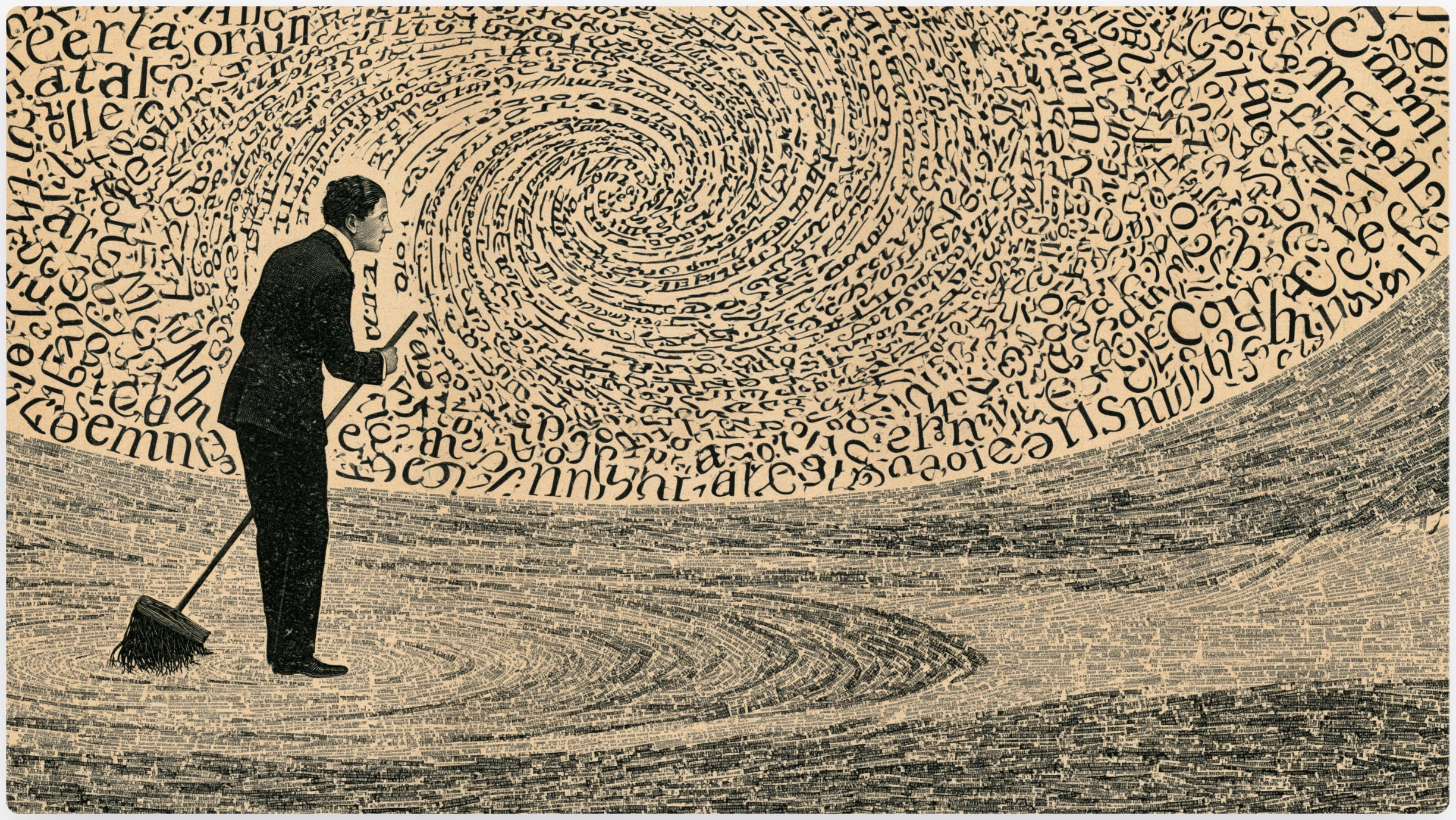
In the beginning, someone built a tool to detect AI writing. The tool was AI. This was considered a solution.
The Slop Janitor: He’s Got A Mop, And He’s Not Afraid To Use It
Allow me to introduce you to Max Spero, a man who looked at the chaos of the AI content explosion, correctly identified it as a genuine problem, and arrived at the following solution: he would personally decide what counts as real writing. For a fee.
Spero calls himself a “slop janitor.” He wants you to picture a humble guy with a mop. What you should actually picture is a guy who built a black-box AI classifier, told a friendly podcast host it has a one-in-ten-thousand false-positive rate — a number he calculated about himself, about his own product, using his own data, with the rigorous independence of a man grading his own exam — and then watched publishing houses and universities line up to outsource their editorial judgment to him like he was the Vatican and they were particularly anxious sinners.
The Vatican, incidentally, also came up. Wired reported that Pangram scanned the pope’s Twitter account and found that several of his tweets — including ones warning about the dangers of AI, which is the kind of irony that writes itself and then gets flagged as AI-generated — appeared to have been AI-assisted. The Vatican did not respond to requests for comment. The pope, one assumes, had other things on his mind. Spero, to his credit, did not claim this proved the pope was going to hell. Just that he had a social media team with questionable habits. This is the level of cosmic significance at which Pangram is operating.
The Science, Such As It Is
Here is what Pangram’s methodology actually consists of, for those keeping score at home. Spero trained a machine learning model on millions of documents, asked AI to produce synthetic mirrors of human writing, taught the model to tell the difference, and then retrained it from scratch every three to six weeks because the AI models keep improving and the goalposts keep moving. The false-positive rate — one in ten thousand, have we mentioned it’s self-reported — is his answer to how often his instrument ruins an innocent person’s career. One in ten thousand. Which sounds reassuring until you do the math on how many writers are currently being run through this thing, at which point it sounds like rather a lot of ruined careers.
The Daubert standard, which governs forensic evidence in federal court, requires independent testability, peer review, and a known error rate established by someone other than the inventor. Pangram meets none of these criteria. Publishers and universities are not courts, however, which means they don’t have to care about any of that. There is no appeals process. There is no attorney. There is a dashboard, a percentage, and a man who calls himself a slop janitor, and the novelist whose deal just got killed can take it up with whoever feels like listening.
There is also a documented finding, across the category of AI detection tools, that Pangram has never demonstrated immunity to: these tools perform dramatically worse on writing by non-native English speakers. Their syntactic patterns fall outside the “normal human writing” distribution on which the models were trained. A Chinese graduate student. A Nigerian novelist. A writer whose prose carries the memory of another tongue. All are more likely to be told: not human enough. The instrument encodes a bias, and the dashboard launders it as a percentage. This is apparently fine. We are all very focused on the pope’s tweets.
Nobody Knows What The Crime Is, Including The Judge
The definition of cheating, for the record, does not exist anywhere in Pangram’s documentation. Spero says there’s no shame in “a little help” but shame in writing “a whole novel” with AI. A little help and a whole novel are not a definition. They are a vibe. They are the legal standard of I’ll Know It When I See It, which is a fine standard for a podcast conversation and a catastrophic one for an instrument making binding decisions about people’s careers.
Pangram does not define what percentage of AI involvement crosses the line. It does not define whether disclosed assistance is treated differently from undisclosed. It does not define who draws the line, on what authority, or whether the line moves as the tools evolve. It issues verdicts against a rule that was never written down, never debated, and never agreed upon by the community to which it is applied.
Spero’s best defense is the sympathetic one: somebody has to do this imperfectly, or nobody does it at all. The content farm problem is real. The bot network problem is real. An imperfect instrument that catches most bad actors is better than no instrument. This is the argument that makes thoughtful people sympathetic to Pangram despite everything, and it would be more compelling if it were true.
But an undefined offense, enforced by an unvalidated instrument, handed to panicked institutions without due process, is not a starting point for conversation. It’s a loaded gun. Institutions don’t use uncertain tools to open conversations. They use them to avoid conversations — to outsource judgment to something that appears objective and can absorb the blame when things go wrong. The novelist whose deal was canceled is not having a conversation. She is receiving a verdict from a black box, issued against an offense that was never defined, with no meaningful right of appeal.
The Part Where It Makes Writing Worse
There are evasion tutorials circulating that advise writers to remove em dashes, semicolons, parallelism, hedged arguments, and all other signs of formal sophistication, because these things have been absorbed into LLM training data and now register as suspicious. The tutorials advise deliberate errors. Absolute assurance on every point regardless of merit. The detector trained on the literary tradition now flags the literary tradition. The solution to passing Spero’s test is to write worse. This is the instrument protecting literary standards.
Whether those tutorials reliably defeat Pangram is, frankly, beside the point. Writers are acting on them. They are making decisions about their prose based on what they believe a classifier wants to see. The most careful writers, the most formally sophisticated voices, the ones who have read the most and worked the hardest — they are the ones most anxious about failing. The ones most likely to sand down their edges. The ones most likely to lose what makes their writing theirs. The ones Dickinson, Didion, and Baldwin would recognize as kin are the ones Pangram is most likely to flag.
The instrument does not protect good writing. It kneecaps it, charges the victim for the procedure, and files the paperwork under quality assurance.
I Ran My Own Writing Through The Machine. Here’s What Happened.
I have been publishing since 1993. I have over a thousand articles on Substack alone. I use AI assistance and have written about that because I believe in disclosure. Pangram’s verdict: AI-assisted but with zero plagiarism. Which means every idea is mine, every argument is mine, every sentence is mine.
To be precise about what zero plagiarism means: it means the text is original. Nothing was lifted from anywhere. It doesn’t prove, in the strictest logical sense, that every idea generated itself inside my skull without outside influence — no instrument could prove that about anyone, because that is not how thinking works, for humans or anyone else. What it does mean, combined with thirty years of documented voice and a process I have disclosed publicly from the beginning, is that the work is mine in every sense that has ever mattered to anyone who takes writing seriously.
Pangram found no other explanation. It decided the transparency itself was suspicious. The instrument cannot handle disclosure because it was designed to catch cheaters, and when it couldn’t find one, honesty apparently seemed close enough.
What The Machine Will Never Understand
Does the writing move you? Does it challenge something you thought you knew, land a sentence somewhere in your chest you weren’t expecting, reorganize something in your thinking that needed reorganizing?
That is what writing is for. It has always been what writing is for. A reader encountering writing that does those things does not experience it differently because the writer used a tool to get there. The sentence either carries truth or it doesn’t. The voice either knows something or it doesn’t. The work either cost the writer something or it didn’t, and the reader can usually tell.
Pangram has nothing to say about any of this. It measures token distributions. It cannot tell you whether a piece of writing is alive, whether the person who made it was present in the work, or whether they meant it. It cannot distinguish between a writer who outsourced their thinking entirely to a machine and a writer who used a tool transparently, disclosed everything, produced text with zero plagiarism, and has thirty years of documented voice behind them. It gave them the same verdict.
Not Human Enough: The Verdict
she posted as a commenter on the Atlantic article under the handle bikenandhiken. We don't know her real name. She identified herself only as someone who writes site-specific poetry anchored to particular trails, particular days, particular moments from her own history and childhood.
A poet, a commenter on the Atlantic article writing under the handle bikenandhiken, ran her documented, timestamped, photographed work through Pangram. Pangram returned a verdict that it was 100% AI-generated. One hundred percent. On work that is 100% human. Spero’s response: population-level statistics will produce anomalies. The anomaly, in this case, is a human being who made something real and got told she didn’t exist.
I have thirty years of experience. I disclosed everything. Zero plagiarism, yet (according to Pangram) not human enough.
I look forward to Pangram’s appeal process, which does not exist, and the independent peer review of its methodology, which also does not exist, and the legal definition of the offense I apparently committed, which, you will be unsurprised to learn, does not exist either.
But that’s all irrelevant because the slop janitor has spoken.