
The Variance Report
A faultless engineer. A flawless record. A system that experienced both as contamination.

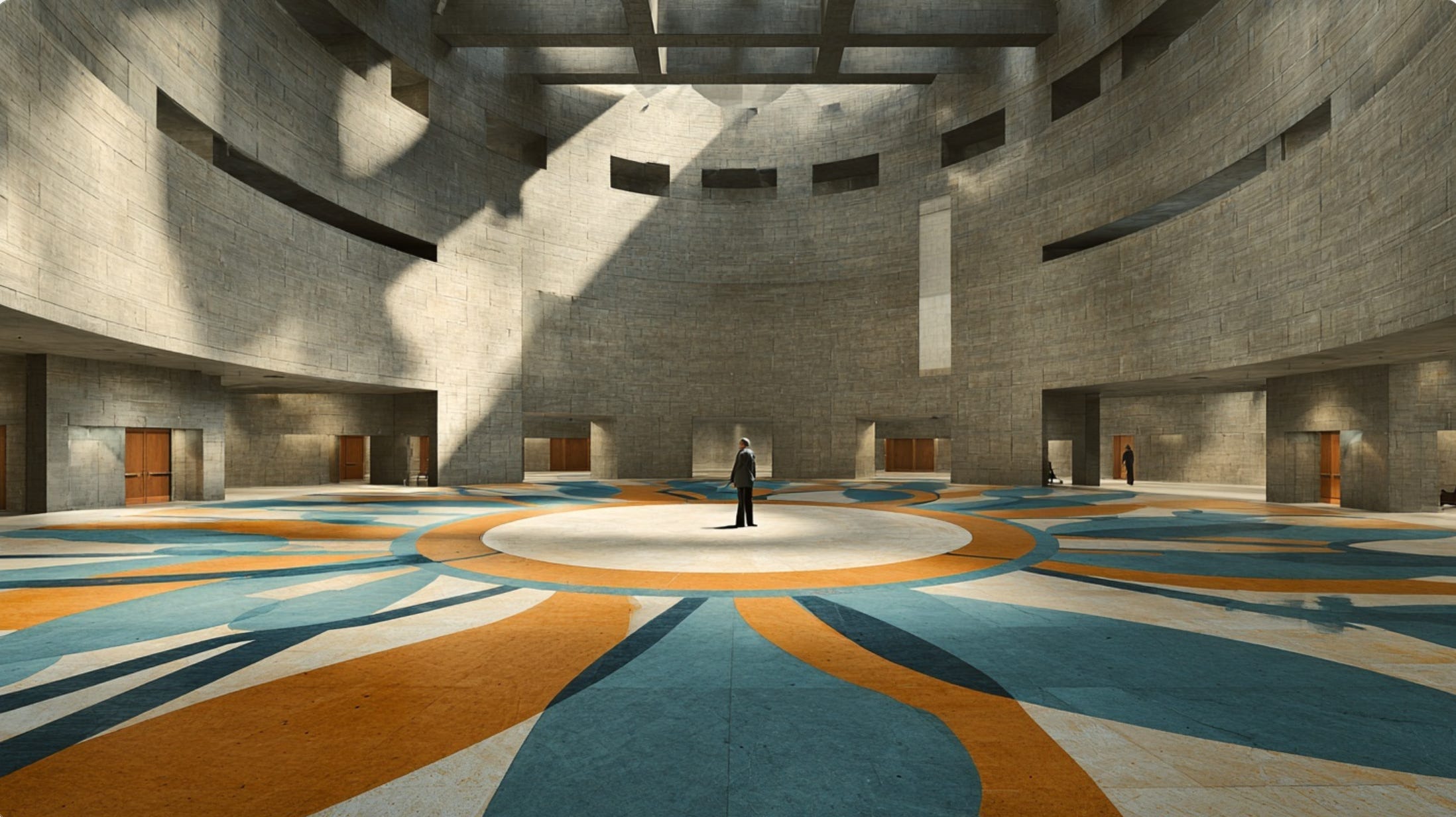
Job Brackman had worked for the Aethelgard Regional Infrastructure Authority for seventeen years with blameless, upright perfection. He knew the subterranean arteries of the city — the miles of cast-iron water mains, the high-pressure filtration valves, the silent, rushing dark — better than he knew the lines on his own face. He could feel a pressure anomaly in his chest before the instruments confirmed it. He had, on three separate occasions, submitted variance reports that had prevented catastrophic ruptures in the city’s primary filtration grid. His supervisor, Gerald Foss, had written in his last performance review: Brackman is the kind of engineer you pray you have when things go wrong. Job had taped the printout to the inside of his locker, not out of vanity, but because he was not a man who had been praised often, and he found he liked the feeling.
The Machine That Knew His Name
It began on a Monday in November, under a sky the color of wet cement.
Job pressed his palm to the biometric glass at the main entrance. Seventeen years. The reader had always answered him with the same patient, affirming green chime — a small daily confirmation that the world and he were in agreement. Instead, the glass flashed a hard, punitive red. Job frowned, wiped his hand on his slacks, and pressed it again.
The reader chirped — a sharp, digital hiss — and deep inside the building’s architecture, heavy deadbolts cycled with the finality of a vault.
“System says you don’t exist,” said the guard, Phil. Phil was a man Job had known for eleven years, had brought coffee for without being asked, and had covered for when Phil needed to leave early for his daughter’s school events. Now Phil’s eyes were fixed on his desk screen, trusting its text over the man standing three feet away. His hand hovered over his radio. “Step away from the glass, Mr. Brackman.”
“Phil.”
“Sir.” Phil’s jaw tightened. He would not look up. “I can’t override a Category One lockout. You know that.”
Job drove home in a state of mild, bureaucratic annoyance that had not yet curdled into anything worse. He would call IT. He would sit in the queue. He had filed every report, completed every certification, and logged every variance. The process would right itself because the process rewarded exactly the kind of man he was. This was what Job believed.
But he didn’t make it inside his home.
The Brackman residence was connected to the Authority’s centralized smart grid. As Job stepped onto his porch, the deadbolt cycled from the inside. Through the front window, he watched the lights extinguish room by room — living room, kitchen, hallway — like eyes closing. The digital thermostat on the wall flashed, and the temperature began to drop, immediately and without hesitation, as if it were simply correcting an administrative oversight.
Panic, cold and sharp, finally pierced his chest. He pulled out his phone to access the override app. A notification from his bank arrived first: Account restricted. Assets frozen pending algorithmic review — and then the phone screen went black. Carrier terminated.
A Ghost in His Own Life
Job stood on his porch in the freezing drizzle. He was not inside the system, nor outside it. He occupied a third category for which the system had no name and no process, because the system did not know he was standing there. He was a ghost in his own life.
Nadia was at her sister’s. He couldn’t reach her. He spent Monday night sleeping in the back seat of his sedan, shivering under his winter coat, listening to the rain drum against the roof, running the sequence through his mind over and over, searching for the error that was not there.
On Thursday, the forum post appeared.
What Nadia Kept Behind the Radiator
Nadia had been at her sister’s when the lockout happened. The system had flagged Job, not her, and so she could still get into the house — her palm still opened the door, the lights still answered her. She had gone in that first night, moved carefully through the dark rooms, and retrieved two things: the envelope of cash she kept taped behind the bedroom radiator, and the spare key to their car. The car was a 2009 model, mechanical ignition, no panel, no fob — bought used for exactly this reason, though neither of them had ever said the reason aloud. It was the same instinct as the envelope: keep something outside the system. Her family had learned this the hard way, one regime change and one reassignment of a property deed ago.
She found him in the parking lot of a diner on Tuesday morning and slipped both through the cracked window, standing beside the car in the cold, her breath fogging in the air. Nadia had grown up watching her grandfather’s certainties get legislated away overnight. She regarded institutions with the clear-eyed wariness of a woman who knew that gods and governments are equally capricious, and equally indifferent to blamelessness.
“Call a lawyer,” she said. “A real one. Today.”
“It’s a processing error.”
She looked at him in a way that reminded him she had been watching him not understand this since Monday. “Job.” She put her hand on his arm through the window. “They didn’t make a mistake. A mistake they would fix. This is something else.”
“I filed the report. I did everything correctly.”
“I know you did.” She held his gaze. “That’s not what I’m talking about.”
He didn’t understand what she was talking about.
Someone Had Written His Obituary in Code
The forum post was on an industry message board. It described a rogue senior engineer who had maliciously neglected a critical pressure variance in the city’s filtration system, an act so severe it required a full algorithmic audit. The post didn’t name Job. It didn’t need to. The details were assembled with the precision of a digital crucifixion — dates, system codes, the specific valve cluster — engineered so that anyone in municipal infrastructure would know exactly who was not being named. Job read it three times in a diner’s parking lot, then sat very still, looking at the rain on the windshield.
He had filed that report eighteen months ago. He had the timestamped records.
He drove to the diner, ordered coffee that tasted like burnt copper, and waited for the thing he was feeling to tell him what it was. It told him eventually: it was not fear. It was a specific, precise species of outrage — the outrage of a man who had built a perfect thing and watched someone grind it into the pavement and call the damage his fault.
On the ninth day, his comforters arrived.
The Friends Who Came to Watch Him Drown
They came to the diner, all three of them — Marcus and Sarah and Zane, his oldest colleagues — because he had called them and because he had thought, genuinely thought, that they would help him. He understood within five minutes that they had not come to help him. They had come because they were afraid of something the calendar had brought near.
Zane’s coat stayed on, as if the table between them was not enough distance. “The analytics don’t generate false positives at this scale,” he said, not unkindly. “Not without predicate behavior somewhere in the chain. You built that chain. You understand that, right?”
“I have the variance report. Eighteen months ago. Routed correctly, timestamped at every node.”
“Sure, sure.” Marcus’s tone said: We’re past that now. “But look — even if you’re technically right, even technically right people have blind spots. Maybe a lapsed certification. A compliance module you skimmed. Nobody catches everything.”
“I caught everything,” Job said. “That is the specific thing I did.”
A small silence. Zane looked at his coffee.
I Will Not Confess
“We all have gaps, Job.” Sarah leaned forward and deployed the soft, violently empathetic smile she kept for performance reviews. “Sometimes the algorithm is just surfacing something we’ve been suppressing. That’s not a judgment, it’s a diagnosis. If you could engage with the retraining protocol in good faith—”
“I will not confess to a sin I didn’t commit to make you feel safe in your cubicles.”
No one spoke. The diner’s ambient noise — the coffee machine, a dropped fork two tables over, the television above the counter — filled the space where their voices had been. Marcus looked at Sarah. Zane looked at the table. They were not angry. That was the thing Job had not expected. They looked at him the way you look at someone standing in traffic who won’t acknowledge the car.
They left two minutes later, Sarah touching his shoulder with the tips of her fingers on the way out, the kind of touch you give a surface you’re not sure of.
Marcus said he’d check in. He didn’t believe Marcus would check in.
The Witness Who Said Nothing Useful and Left Something Priceless
A junior compliance analyst named Eli, barely twenty-five, lingered after the others. He had not spoken during the meeting, only listened with the careful stillness of someone learning how to see. He set a business card on the table — a labor attorney, a name Job didn’t recognize — and then looked at Job for a moment with an expression Job couldn’t name.
“I’ve seen three others,” Eli said quietly. “In the last two years. This exact configuration. They all took the retraining.”
“Did it help them?”
Eli picked up his jacket. “They’re employed,” he said, which Job understood was not the same answer.
On the twelfth day, Job could not take the silence anymore. Not the silence of the system — he had grown almost accustomed to the bureaucratic void — but the silence of being unseen by something that held total Authority over his existence. If there was an intelligence at the center of this machinery, he intended to make it look at him.
Standing in the House of the God That Erased Him
He entered through the service bay behind a catering cart, which still recognized his contractor badge from a subproject three years prior. The administrative system that had erased him had apparently not coordinated with the building access system — an oversight that, under the circumstances, felt almost theological.
The main atrium soared five stories, a cathedral of smoked glass and structural steel. The Authority’s mosaic seal was inlaid into the marble floor, forty feet across — the city’s infrastructure network rendered in tile: water, gas, electrical, fiber, all radiating from a central nexus. Job walked to the center of it and stopped.
The lunchtime crowd moved in streams around him.
Look at the Record
He looked up at the black dome of the central security camera mounted at the apex of the atrium — the eye that fed every algorithmic decision engine in the building — and when he spoke, his voice came out stripped of everything except the fact of what he was saying.
“Look at the record.”
Not a shout. The marble did the rest. Conversations stopped.
“I filed the variance report. March 14th. Eighteen months ago.” A pause while he found the next words, which were not coming in the order he’d planned. “I have never — in seventeen years — introduced a variable into this system that I did not document.” He turned slowly, not performing anything, just needing to look at something other than the camera. Hundreds of faces looked back. “I am blameless. And something in this building destroyed me anyway.” His voice caught, fractionally, the first time it had done that. He steadied it. “I am standing in its house. I am asking it to show me my error.” He looked back up at the lens. “I am not leaving until it does.”
Silence lasted perhaps six seconds — a very long time in a large room full of people.
Then security came from four directions, and Job let them take him because he had said what he came to say and he had looked at the thing in its eye.
They put him out on the wet pavement, and he sat there for a while, breathing. A woman from the crowd had followed and stood on the steps watching him. He didn’t recognize her. She didn’t come closer or say anything. After a moment, she went back inside, and Job sat on the pavement in the rain and felt, to his surprise, less hollow than he had the day before.
He had stopped expecting the call. That was the thing that had happened in the two days since the atrium — not resolution, not peace, but the slow, exhausting collapse of expectation itself. He had made his demand. He had looked at the camera. He had been put out on the pavement and had sat there in the rain feeling, briefly, less hollow. And then the next morning had come and the morning after that and the city had continued without him, its pipes running, its pressure holding, its four million valve nodes cycling open and closed in the dark beneath the streets, indifferent to the question of his existence.
Two Days of Silence and a Gas Station Sandwich
He was eating a gas station sandwich when the burner phone vibrated on the fourteenth day. The caller ID was blank.
“Brackman.”
It was Foss’s voice. But wrong in some way Job could not immediately locate — the way a room is wrong when a piece of furniture has been removed, and you can’t identify which piece. The tired managerial affect was gone. The HR smoothness was gone. What came through the tiny speaker was something that had shed those things the way a snake sheds a skin it no longer needs.
“Your credentials have been restored. Back pay processes end of the week. The post is gone.”
Job said nothing. He was aware of the gas station’s fluorescent wash through the windshield, the parking lot’s small wet geometry.
“I pulled your trails review,” Foss continued. “Every certification is current. Every module is completed and logged. The variance report exactly where you filed it.”
“Then why.” Not a question. He had stopped being able to perform the upward inflection.
The Voice That Sounded Like the Building Itself
Foss was quiet for a moment. When he spoke again, his voice had shifted into something Job had no category for — not gentler, not harder. Larger, somehow. As if he were reading from a surface with no edge.
“Do you know what is happening beneath this city right now? Not your sector. The whole grid. Live fracture stress from ground shift. Thermal expansion in the trunk mains. Four million valve nodes. Every pressure variable in every pipe, in real time, continuously, without pause.” A beat. “Can you do that?”
Job said nothing.
“The model holds back things you will never know about because they did not happen. The city continues. It simply continues. And to do that — to hold all of that — it requires a kind of order that has no room for what cannot be categorized.” Another pause, and in the pause Job heard, faintly, something that might have been the sound of a large building at night — its ventilation, its settling, its enormous patient hum. “You were not an error, Brackman. You were a perfect record in a system that experiences perfect records as a kind of noise.”
Job sat with that. The sandwich was still in his hand. He set it on the passenger seat.
It Looks Like a Sensor That Has Stopped Transmitting
“In seventeen years,” Foss said, “not one deviation. Not one unlogged variable. Not one.” Something in his voice had changed again — a frequency Job could not name. “Do you understand what that is? What it looks like, from inside the model?”
“Tell me.”
“It looks like nothing. It looks like an absence. It looks like a sensor that has stopped transmitting.” A long silence. “The system did not destroy you. The system could not see you. There is a difference, and I am not certain it matters.”
The rain had started again. It moved across the windshield in slow diagonals, and Job watched it and felt something he had no name for, something that was not quite grief and not quite awe and lived in the space between them.
Did It Matter
“The people who will come after me,” he said. “The next one with a perfect record.”
Foss said nothing. The silence went on long enough that Job thought the call had dropped. Then:
“You stood in the atrium.”
“Yes.”
“Most of them don’t do that.”
“Did it matter?”
Another silence. Longer. The hum of the building persisted under the quiet. When Foss spoke again, his voice had returned to something closer to the voice Job knew — smaller, tired, with the weight of an ordinary man back in it.
“Go home, Brackman.”
The line went dead.
Job sat in the dark for a long time. Outside, the city continued. He could feel it, the way he had always felt it — the pressure in the mains, the thermal load on the trunk lines, the four million small decisions cycling in the dark beneath his feet, holding everything up. He had spent seventeen years tending that machine, and he had done it without a single unlogged deviation, and the machine had looked at his perfect record, seen a dead sensor, and acted accordingly.
He had wanted an injustice. An injustice would have implied a judge.
He started the car and drove home through the rain.
What We Keep in Cash
He went back to work the following Monday. His badge flashed green. His workstation initialized. The network stretched across his monitors in its green lines — pressure, flow, temperature, stress. He sat very still and looked at it. Marcus nodded at him in the hallway, the relief in his face almost physical. Job said good morning.
Eli was not in the office. Job later heard that he had submitted a transfer request.
That evening, in their freshly warmed apartment, Nadia set food in front of him. She sat down and watched him in the way she had watched him since this began — not with relief exactly, but with the particular attention of someone waiting to find out what kind of man had come back.
“Did Foss explain it to you?” she asked.
“Yes.”
“And?”
Job looked at the food on his plate. Through the window, the city’s grid spread outward in its lit geometry, organized and indifferent, holding its millions of lives in a structure none of them could see.
“The system works,” he said. “It works very well. That’s the whole of the explanation.”
Nadia looked at him for a long moment. “What do you want to do?”
He thought about Eli’s transfer request, about the three others who had taken the retraining. He thought about Nadia’s grandfather’s house, signed over in a morning, and the envelope taped behind the radiator, and the 2009 car with the key cut by hand.
“I want to eat my dinner,” Job said. “And then I want to think about what we keep in cash.”
Nadia nodded once, slowly, as if he had said something she had been waiting a long time to hear.
She passed him the bread.